Lately I have been spending a lot of time diving deep into both artificial intelligence and hypnotherapy. Having a background that sits at the intersection of complex systems, technical frameworks, and human behavior naturally drives me to bridge the two, finding patterns where cognitive architecture and machine intelligence mirror each other.
When comparing human cognition to artificial intelligence, the standard argument is that AI runs on cold mathematical weights, while humans run on emotion and subjective feeling.
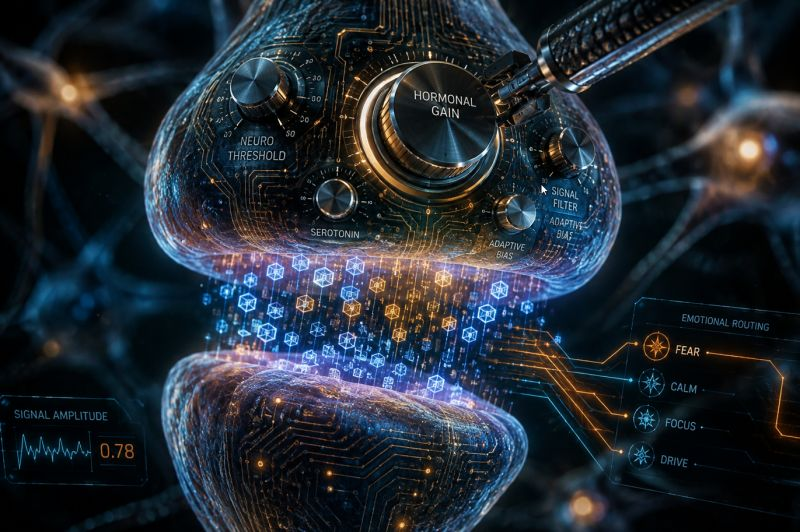
From a neuro-systemic perspective, a different question emerges: what if emotions and hormones are simply dynamic gain controls and network routers?
The mechanics align remarkably well.
Emotions as Network Topology Routers
An emotional response (fear, curiosity, awe) instantly shifts electrical pathways away from surface-level processing and reroutes signals down specialized neural corridors. It changes where the electricity flows.
Topology in motion. The network you had a moment ago is not the network you have now.
Hormones as System Gain Control
Chemical modulators like cortisol, dopamine, or oxytocin alter synaptic resistance. They amplify or dampen signal strength, dictating how deeply an electrical cascade propagates across the network.
A frightened brain has different gain settings than a curious one. Same hardware, different calibration.
Single-Shot Weight Updates
High-arousal emotional events release massive hormonal surges that lower the threshold for long-term potentiation. Essentially: an instant, high-learning-rate update that stamps a pattern deep into subconscious cold storage.
One event. One stamp. Decades of downstream behavior.
Hypnosis as Gain Recalibration
When we quiet the conscious noise through deep trance or hypnotherapy, we are not changing the hardware. We are altering the current gain adjustments and signal routing, allowing electrical currents to flow into deep, unindexed parameter space that daily survival filters keep hidden.
Whether that complex, self-rewiring loop creates genuine subjective awareness or is simply hyper-advanced biological computing remains the open question. But viewing emotional states as signal routing fundamentally changes how we inspect the backend system.
Are your choices today being guided by active, real-time reasoning, or by high-gain emotional scripts routed decades ago?